
For years, digital therapeutics lived in an awkward middle ground — clinically credible, but with no reliable way to get paid for prescribing or managing them. That changed fast. Between new FDA clearances and a dedicated CMS billing pathway, DTx has moved from a pilot-program curiosity to something clinics can build a real revenue line around. This playbook walks through what’s now billable, which clinical categories are leading adoption, and how to build the operational and technical infrastructure to prescribe DTx at scale.
Why DTx Is Moving from Pilot to Standard of Care in 2026
The regulatory and financial signals are lining up at the same time, which is rare in healthcare and worth paying attention to.
On the regulatory side, 42 FDA-cleared prescription DTx as of June 2026 marks a real maturation point — clearances now span mental health, diabetes, and hypertension rather than clustering in a single niche indication. Explore our DTx and digital therapeutics solutions page for how this expanding landscape maps to specific clinical programs.
On the payment side, CMS launched DTx payment codes in 2025 for mental health & chronic disease, which is the piece that actually makes prescribing sustainable for clinics rather than something absorbed as an unreimbursed cost center. See our reimbursement and billing services page for the operational detail behind this shift.
And the market is responding accordingly: the U.S. DTx market $6.73B–$13.93B in 2026 (20.7%–34% CAGR) reflects payers, providers, and patients converging on evidence-based software therapies as a legitimate care modality rather than an experimental add-on. Our market research and insights page tracks this growth in more depth.
What Counts as FDA-Cleared Prescription Software for Chronic Disease Management
Before building a DTx program, it’s worth being precise about what actually qualifies — the term gets used loosely, and reimbursement depends on getting the definition right.
At its core, this means FDA-cleared prescription software for chronic disease management (depression, diabetes, hypertension) with coaching, medication adherence tracking, and outcomes reporting, delivered under a clinician’s plan of care rather than as a standalone consumer wellness app. This is the category our DTx solutions page is built around.
The regulatory pathways matter here. Most clearances run through 510(k) or De Novo authorization under 21 CFR 882.580 for behavioral health indications, with the framework now expanding into metabolic and cardiovascular applications as evidence accumulates.
Clinically, there are guardrails that separate a reimbursable DTx from a generic health app: it has to be used alongside ongoing professional services, documented within a formal treatment plan, and tied to measurable outcomes — PHQ-9 scores, A1C, or blood pressure trends, depending on the indication. Skip any of these and you’re not just risking a denied claim, you’re outside the clinical model the FDA clearance was built around.
CMS DTx Payment Codes (2025–2026): What’s Billable and How
This is the section clinics actually need memorized, because getting the codes right is the difference between a DTx program that pays for itself and one that quietly loses money every month.
The core codes break down as follows:
- G0552 — device supply plus initial education and onboarding for an FDA-cleared DTx, currently centered on mental health with chronic disease expansion under active consideration.
- G0553 — the first 20 minutes of monthly treatment management, requiring at least one interactive communication with the patient.
- G0554 — each additional 20 minutes of monthly management beyond the initial block.
Run the reimbursement math and you’re looking at roughly $180 per patient per year when combining device supply and management minutes, though this varies meaningfully by locality and payer mix — don’t take that figure as a guarantee without checking your specific fee schedule.
Documentation is where a lot of otherwise-solid DTx programs run into trouble. At minimum, you need FDA clearance status on file, a documented plan of care, accurate time logs, records of interactive contacts, and outcomes tracking — PHQ-9, A1C, or BP trends depending on indication. Auditors will ask for all five; missing any one of them turns a clean claim into a denial risk.
Depression DTx with CBT Modules and PHQ-9 Tracking
Mental health is where DTx has the deepest evidence base, and it’s worth understanding the clinical model in detail since it’s likely to set the template for how newer indications get evaluated. Depression DTx with CBT modules and PHQ-9 tracking delivers psychoeducation, cognitive restructuring, and behavioral activation through a smartphone app, with clinician oversight built into the loop rather than left to the patient alone. Our behavioral health and mental health DTx page covers specific product options in this category.
The outcomes evidence is genuinely encouraging: trials report PHQ-9 reductions of roughly 2–3 points over 6–16 weeks, with non-inferiority to in-person therapy for mild-to-moderate depression in several recent studies. That’s not a claim that DTx replaces therapy across the board — it’s a claim that for a specific, well-defined patient population, it holds up.
Operationally, this tends to work best when prescribed either at intake or between visits, with monthly management codes used to review adherence, track PHQ-9 trends, and escalate to live therapy the moment the data suggests the app-based intervention isn’t enough on its own.
Diabetes DTx with Health Coaching and CGM Integration
Diabetes DTx with health coaching and CGM integration combines nutrition tracking, personalized meal recommendations, SMART goal-setting, and behavioral training — and in some RCTs, drives A1C reductions comparable to what you’d see from pharmacotherapy alone. Our diabetes digital therapeutics page breaks down the specific clinical evidence behind these numbers.
The data flow is what makes this category distinct from a standalone coaching app: continuous glucose monitor data flows into the app, generates coaching insights, and surfaces on a clinician dashboard, with automatic alerts for hypo- or hyperglycemic events and adherence gaps that would otherwise go unnoticed between visits.
On reimbursement, diabetes DTx pairs naturally with existing CCM or RPM billing where appropriate, so the practical move is to track coaching minutes and outcomes carefully now — both for current value-based contracts and to be positioned for whatever DTx-specific expansion codes CMS introduces for chronic disease indications going forward.
Hypertension DTx with Medication Adherence Nudges and BP Trend Dashboards
Hypertension DTx with medication adherence nudges and BP trend dashboards uses data-driven prompts, lifestyle coaching, and home blood pressure integration to reduce systolic blood pressure by roughly 2–4 mmHg in real-world cohorts — a modest but clinically meaningful shift at population scale. See our cardiovascular and hypertension DTx page for the full clinical rationale.
The engagement mechanics are personalized rather than static: nudges are tied to the individual patient’s activity levels rather than sent on a fixed schedule, with monthly summaries delivered to clinicians that include threshold alerts and adherence scores rather than raw, unfiltered data.
Outcomes reporting here tracks systolic and diastolic trends, adherence rates, and lifestyle activity, and integrates naturally with existing RPM workflows for the highest-risk patients where blood pressure volatility is the primary clinical concern.
Integrating DTx with Remote Patient Monitoring Software

DTx and RPM aren’t competing categories — they’re complementary layers, and the strongest programs treat them that way from the start. Remote patient monitoring software provides the sensing layer — BP cuffs, CGMs, connected scales — while DTx delivers the therapeutic layer of coaching, CBT, and adherence nudges. Our RPM product and services page covers how these two layers typically get wired together.
The architecture pattern that works: device data flows into a FHIR Observation resource, feeds into the DTx engine, and surfaces on both a clinician dashboard and the patient-facing app, with closed-loop alerts and care plan updates happening automatically rather than requiring manual reconciliation between two separate systems.
Billing alignment deserves particular attention here. DTx management minutes and RPM/CCM time need to be coordinated carefully, with distinct documentation for each — double-counting the same minutes across both code sets is one of the more common audit triggers in programs that run DTx and RPM side by side.
Building or Buying: Partnering with the Right Healthcare Software Development Company
Every organization launching a DTx program faces the same fork: adopt an existing FDA-cleared product, or build something custom. Neither answer is universally right.
Buy makes sense when you want a turnkey FDA-cleared DTx with existing EHR integrations and billing support already worked out — speed to launch usually wins here.
Build becomes the better path when you’re developing custom FDA-cleared prescription software for chronic disease management targeting a niche indication or a genuinely novel behavioral model that off-the-shelf products don’t cover.
Either way, when evaluating a healthcare software development company for this work, look specifically for regulatory expertise spanning both FDA and HIPAA requirements, real FHIR/HL7 integration experience, AI/ML pipeline capability for personalization, and outcomes analytics that can actually support the documentation CMS billing requires. Our company overview and capabilities page outlines what we consider the baseline for this kind of work.
Custom EHR, EMR & PHR Software Development for DTx Workflows
Standard EHR configurations weren’t built with DTx prescribing in mind, which is why tailoring Custom EHR, EMR & PHR Software Development specifically for DTx workflows matters as much as picking the right therapeutic product. Our EHR/EMR/PHR services page covers this in more detail.
In practice, that means being able to e-prescribe DTx the same way you’d prescribe a medication — with indication, duration, and renewal rules built into the order set — along with embedded outcomes dashboards (PHQ-9, A1C, BP) and adherence tracking directly inside the clinician’s existing workflow rather than a separate system they have to check independently.
On the patient side, portal and PHR views need to surface progress tracking, nudges, and secure messaging in one place. And none of it functions well without interoperability — write-back to hospital systems, payer APIs, and HIEs — to support both coordinated care and the value-based reporting that increasingly determines contract performance.
Hospital Management Software Development Company for System-Wide DTx Scale
DTx doesn’t have to stay confined to outpatient clinics. A Hospital Management Software Development Company can embed DTx prescribing into discharge planning, chronic care clinics, and behavioral health programs at the system level — see our HMIS and hospital management solutions page for the broader scope of this work.
The relevant modules — care transitions, pharmacy, care management, and analytics — need to integrate directly with DTx prescribing and outcomes tracking rather than operating as a parallel, disconnected system.
Done well, this shows up as reduced readmissions, improved HEDIS and Star ratings performance, and genuinely new revenue streams through DTx paired with RPM/CCM bundles — not just better documentation, but better financial outcomes tied directly to the clinical ones.
Implementation Playbook: From First Prescription to Population Health
Rolling out a DTx program system-wide tends to follow a consistent sequence, regardless of which indications or vendors you start with.
Step 1 — Select indications. Choose from depression, diabetes, or hypertension to start, and map each to your existing care pathways rather than building a parallel process from scratch.
Step 2 — Configure the workflow. Build EHR order sets, patient onboarding flows, and outcomes collection mechanisms for PHQ-9, A1C, or BP tracking, depending on the indication.
Step 3 — Train care teams. Make sure staff understand DTx management minutes, the documentation CMS requires, and clear escalation rules for when a patient needs to move beyond the app-based intervention.
Step 4 — Monitor and iterate. Track adherence, clinical outcomes, and ROI on an ongoing basis, and adjust nudge frequency, coaching intensity, and patient segmentation based on what the data actually shows.
Measuring What Matters: KPIs for DTx Programs
A DTx program without clearly defined KPIs is hard to defend in a budget review, no matter how good the underlying clinical evidence is. Track across four categories:
- Clinical: PHQ-9 change, A1C reduction, and SBP/DBP control rates
- Engagement: activation rate, module completion, and coaching session attendance
- Financial: DTx reimbursement per patient, RPM/CCM bundling revenue, and total cost of care impact
- Equity: access across demographic groups, language support availability, and accommodations for varying digital literacy
The equity dimension is easy to skip and increasingly important — a DTx program that shows strong average outcomes but systematically underperforms for specific patient populations isn’t actually the success story the topline numbers suggest.
The Road Ahead: Evidence, Expansion, and Integration
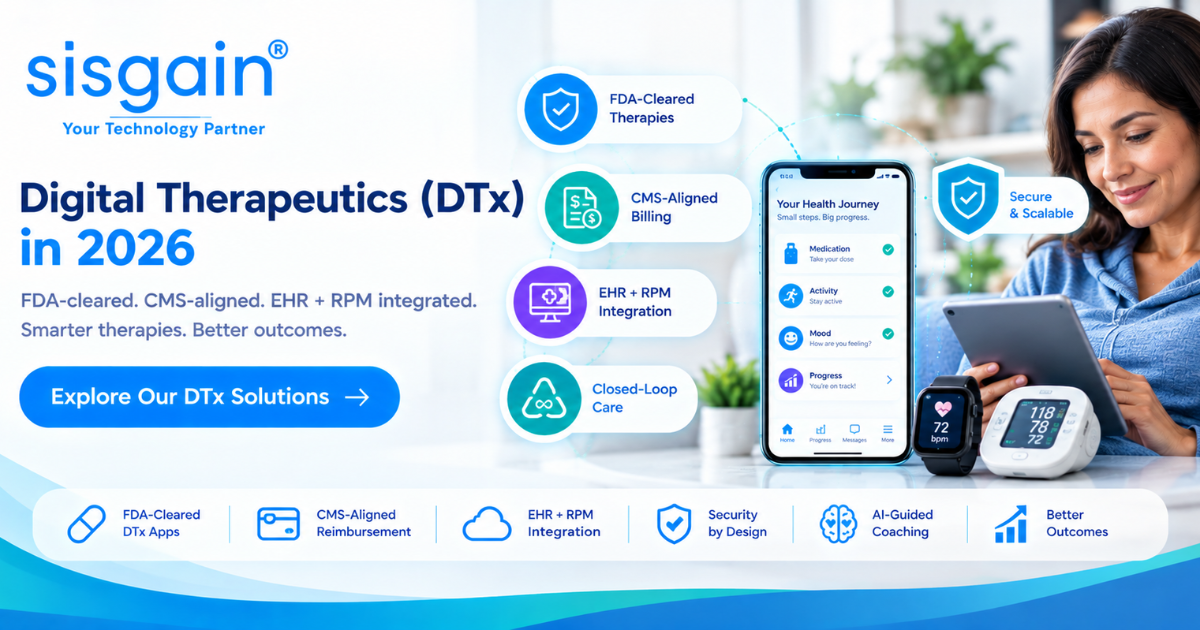
The programs succeeding with DTx in 2026 share a formula: FDA-cleared therapies, CMS-aligned billing built into the workflow from day one, and FDA-cleared prescription software for chronic disease management integrated tightly with EHR and RPM systems for genuinely closed-loop care.
What separates the leaders from everyone else running a DTx pilot isn’t the specific app they chose — it’s security-by-design, clearly defined escalation paths for AI-driven coaching, and an architecture built to scale elastically without fracturing compliance or eroding the clinical trust the entire reimbursement model depends on.