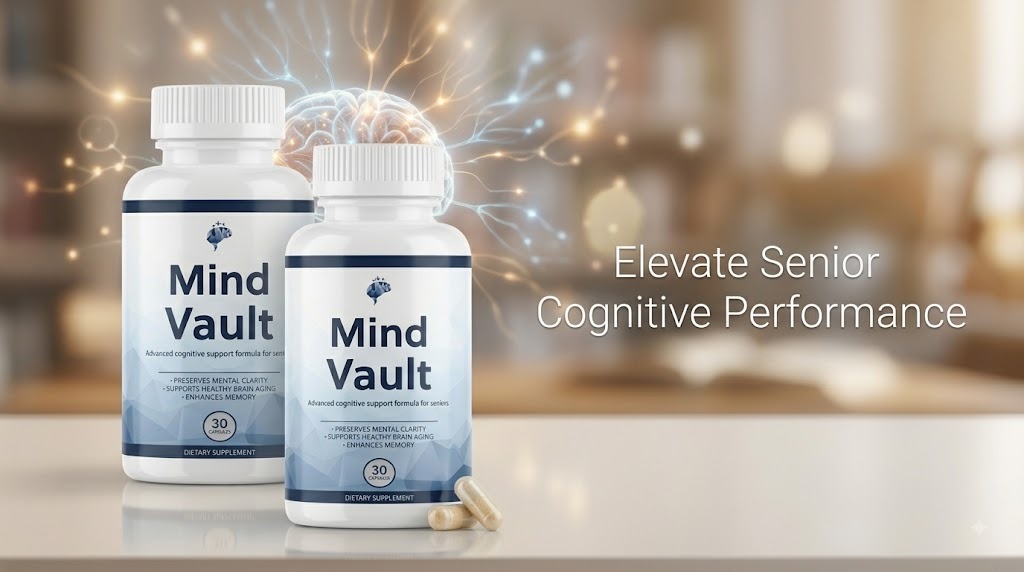
Mind Vault
Mind Vault Review: Does This Brain Health Supplement Actually Work? (2026 Honest Breakdown)
Brain fog, forgetfulness, and that “where did I put my keys” feeling aren’t just annoying — for a lot of people they’re a daily source of stress. That’s exactly the itch that “Mind Vault,” a cognitive support supplement marketed heavily toward adults over 45, claims to scratch.
But before you add anything to your cart, it’s worth slowing down. We dug into the product, the ingredients behind it, and — importantly — how it’s being sold online. Here’s what we found, in plain language, with the marketing hype stripped out.

What Is Mind Vault?
Mind Vault is positioned as a natural nootropic (a supplement marketed to support memory, focus, and mental clarity) built around a blend of botanical extracts and compounds that show up frequently in the brain-health supplement category: ingredients like Bacopa Monnieri, Alpha-GPC, Ginkgo Biloba, Phosphatidylserine, Huperzine A, and sometimes Lion’s Mane Mushroom or Acetyl-L-Carnitine, depending on which version of the formula you come across.
That “depending on which version” part is worth pausing on. As we researched this product, we found the same “Mind Vault” name and nearly identical sales copy running across a large number of different websites and domains — not one official manufacturer site, but many, each with slightly different claims, pricing, and guarantee windows (60-day guarantees on some, 365-day on others). Some pages describe it as suited for “anyone,” while others narrow it specifically to adults 45+. This kind of fragmented, copy-pasted marketing across multiple lookalike URLs is a pattern worth knowing about — more on that below.
Who Is It Marketed To?
Most versions of the product page target:
- Adults 45 and older noticing more frequent “senior moments”
- People experiencing work-related brain fog or mental fatigue
- Students or professionals who want sharper focus during demanding tasks
- Anyone concerned about long-term brain aging and wanting a “natural” option
How Mind Vault Claims to Work
The marketing describes a multi-pathway approach, generally built around four ideas:
1. Supporting Acetylcholine Levels
Acetylcholine is a neurotransmitter genuinely involved in learning and memory formation. Ingredients like Alpha-GPC and Huperzine A are included because Alpha-GPC is a choline source (a building block for acetylcholine), and Huperzine A inhibits the enzyme that breaks acetylcholine down. This mechanism is real and reasonably well understood at a biochemical level — the open question is always whether a specific dose in a specific product translates into a noticeable real-world benefit.
2. Improving Cerebral Blood Flow
Ingredients like Ginkgo Biloba and Panax Ginseng are included for their purported ability to support blood circulation to the brain, on the theory that better blood flow means better oxygen and nutrient delivery to brain tissue.
3. Protecting Neuronal Membranes
Phosphatidylserine and DHA are framed as supporting the structural integrity of brain cell membranes, since these compounds are naturally present in cell membranes throughout the body.
4. Fighting Oxidative Stress
Various antioxidant compounds are included on the premise that oxidative stress contributes to age-related cognitive decline, and that neutralizing free radicals may help preserve cognitive function over time.
This is a coherent story. The question that actually matters for your wallet is: what does the research say about each ingredient individually?
What the Research Actually Says About the Key Ingredients
This is where we think most reviews fall short — they either uncritically repeat the sales page or dismiss the whole category outright. The honest answer is more nuanced: some of these ingredients have real, if modest, clinical support. Others are much weaker than the marketing implies.
Bacopa Monnieri
Bacopa is probably the best-studied ingredient in this entire category. Multiple systematic reviews and a meta-analysis of randomized controlled trials have looked at Bacopa’s effect on cognition in healthy adults. The consistent finding across this research: <cite index=”10-1″>trials using Bacopa extracts at doses of 300–450 mg per day, taken over roughly 12-week periods, tend to show benefits for memory, particularly free recall</cite>, while <cite index=”10-1″>evidence for improvement in other cognitive domains is weaker, partly because those domains are studied less consistently</cite>.
A separate meta-analysis reached a similar but slightly different conclusion, finding <cite index=”13-1″>that Bacopa appeared to enhance memory free recall specifically, with effects broadly comparable to those reported for Panax Ginseng and modafinil in healthy, mostly younger adults</cite>.
It’s worth being clear-eyed about the limits here, too. When researchers looked specifically at Bacopa for treating Alzheimer’s-related dementia rather than general memory support in healthy adults, the picture was much weaker — a 2022 systematic review found <cite index=”12-1″>no meaningful difference between Bacopa and either placebo or the prescription drug donepezil, based on very low-certainty evidence, due to high risk of bias and small sample sizes across the available trials</cite>. In other words: Bacopa has some real signal for everyday memory support in healthy adults, but it is not a treatment for dementia, and anyone marketing it that way is overstating the science.
Bottom line: Bacopa is one of the more evidence-backed ingredients in the “brain supplement” world. It’s not a miracle worker, and effects are modest — but it’s a legitimate inclusion, not just marketing filler.
Alpha-GPC and Huperzine A
Both compounds have plausible, well-documented mechanisms (choline supply and acetylcholinesterase inhibition, respectively), and Huperzine A specifically is a compound that’s also been studied as an adjunct in dementia care because of that mechanism. The caveat: the doses used in over-the-counter blends like this are typically much lower than doses used in clinical trials, and proprietary blends often don’t disclose exact milligram amounts per ingredient — which makes it hard to know if you’re getting a clinically relevant dose or a token amount.
Ginkgo Biloba
Ginkgo is one of the most extensively studied “brain” supplements in the world, and it’s also one of the most debated. Some trials show modest benefits for attention and mild age-related cognitive symptoms; other well-designed trials — including large ones looking at dementia prevention — have found no meaningful benefit. The honest summary most researchers land on: Ginkgo’s effects, if they exist for everyday cognitive support, are small and inconsistent across studies.
Phosphatidylserine, DHA, and Lion’s Mane
These have reasonable biological rationale (they’re structural components of neurons or, in Lion’s Mane’s case, linked to nerve growth factor stimulation in preclinical research), but much of the strongest data is either from animal studies or small human trials that haven’t been widely replicated. They’re not junk ingredients — they’re just further behind on the evidence curve than Bacopa.
Red Flags We Found While Researching Mind Vault
We want to be direct about this part, because it’s more important than the ingredient breakdown.
1. Multiple “Official” Websites With Identical Copy
Rather than one manufacturer with one official site, “Mind Vault” appears across numerous different domains — some using near-identical brand names with subtle spelling variations. Each site reuses large blocks of the same marketing language, sometimes word-for-word, with different pricing, different guarantee lengths (60 days on some pages, 365 days on others), and different target audiences (some say “for anyone,” others say “for adults 45+ only”). Legitimate supplement brands typically have one canonical site and consistent claims. A sprawl of lookalike domains repeating the same script is a hallmark of affiliate-driven, high-volume marketing funnels rather than a single accountable manufacturer.
2. Misleading Regulatory Claims
Some product pages describe Mind Vault as “FDA-approved.” This is a claim to be skeptical of: the FDA does not approve dietary supplements the way it approves prescription drugs. Supplements are regulated under a different framework (DSHEA), and manufacturing facilities can be FDA-registered — which is a much lower bar than FDA-approved. If a supplement claims outright FDA approval, that’s worth double-checking directly, because it’s a claim regulators specifically warn consumers about.
3. Aggressive Discount Framing
Phrases like “$366 off,” “80% off,” and countdown-style urgency pricing are common tactics in direct-response marketing funnels. They’re not automatically disqualifying, but they’re designed to short-circuit comparison shopping — which is exactly the moment to slow down, not speed up.
4. Unverifiable Review Counts
Claims like “48,000+ reviews” with a suspiciously high average rating, displayed on a page with no independent, checkable review platform, should be treated as marketing copy rather than verified social proof.
None of this proves the product is fraudulent or that the ingredients inside won’t do anything. But it does mean the marketing around Mind Vault deserves more scrutiny than the marketing around an established, single-source supplement brand with transparent third-party testing.
Pricing and Guarantee — What We Actually Found
Pricing varies significantly depending on which site you land on — we saw figures ranging from roughly $38 to $49 per bottle depending on the bundle and the specific site, with steep “discounts” advertised off inflated list prices. Guarantee windows also varied by source, from 60 days to as long as 365 days. Given the inconsistency across sites claiming to be the “official” seller, we’d strongly recommend reading the actual refund terms on whichever specific page you’re buying from — screenshot them before you order — rather than trusting a general claim.
Why People Choose Mind Vault
People may choose Mind Vault because it is positioned as a convenient daily brain wellness supplement designed to support areas such as memory, focus, concentration, and mental clarity. For individuals looking to maintain an active and productive lifestyle, a supplement with a cognitive wellness focus may be appealing as part of a broader daily routine. Mind Vault is also presented as an easy option for people who prefer a simple, consistent approach to nutritional support rather than making major changes to their routine. Another reason people may consider it is its emphasis on overall cognitive wellness rather than focusing on just one area of mental performance.
How to Evaluate Mind Vault (or Any Brain Supplement) Before Buying
Instead of taking any single review’s word for it — including this one — here’s a practical checklist:
Check the Label, Not the Landing Page
Look for a full ingredient list with actual milligram doses, not just a list of ingredient names. “Proprietary blend” without dosages is a common way to include clinically studied ingredients at doses too low to matter.
Look for Third-Party Testing
Reputable supplement companies use independent labs (like NSF, USP, or ConsumerLab) to verify that what’s on the label is actually in the capsule. If a brand doesn’t mention third-party testing anywhere, that’s worth factoring in.
Search for the Brand Independently
Search the brand name alongside terms like “reviews,” “complaints,” or “lawsuit” on a neutral search engine — not through a link on the sales page itself — before purchasing.
Be Wary of Multiple “Official” Sites
If you find more than one site claiming to be the sole official seller, with different prices and different guarantee terms, treat that as a signal to slow down and verify which (if any) is legitimate before entering payment information.
Talk to a Healthcare Provider First
This matters most if you take blood thinners, thyroid medication, or medication for a psychiatric condition — several common nootropic ingredients (including Ginkgo and Huperzine A) can interact with prescription drugs.
Realistic Expectations: What a Supplement Like This Can and Can’t Do
Even in the best-case scenario — where every ingredient is dosed exactly as studied in clinical trials — the realistic effect of something like Bacopa Monnieri is a modest improvement in memory recall over weeks of consistent use, not a dramatic transformation. No over-the-counter supplement is going to replace sleep, exercise, a nutrient-dense diet, stress management, or social engagement, all of which have far stronger and more consistent evidence bases for long-term brain health than any single pill.
If you’re dealing with memory changes that feel significant, sudden, or are affecting daily functioning, that’s a conversation for a doctor — not a supplement funnel, however persuasive the copy is.
Frequently Asked Questions About Mind Vault
Is Mind Vault safe to take?
The individual ingredients commonly listed (Bacopa, Ginkgo, Alpha-GPC, Huperzine A, Phosphatidylserine) have generally been reported as well-tolerated in clinical research at studied doses, with mild side effects like digestive upset being the most commonly reported issue. That said, without knowing the exact dose in a specific bottle, and given interactions with certain medications, it’s worth checking with a pharmacist or doctor before starting.
Does Mind Vault treat dementia or Alzheimer’s disease?
No. Even the ingredient with the strongest research behind it, Bacopa Monnieri, has not shown a meaningful benefit over placebo specifically for Alzheimer’s-related dementia in rigorous reviews. Any product implying it can treat, cure, or prevent a diagnosed neurological condition should be treated with significant skepticism.
Why are there so many different Mind Vault websites?
This is one of the more unusual aspects of researching this product. Multiple domains use the same or very similar branding and near-identical sales copy, with different prices and guarantee terms. This is consistent with a high-volume affiliate marketing model rather than a single, centrally managed brand — which makes it harder to verify who you’re actually buying from.
How long does it take to notice results from a supplement like this?
Marketing pages for products in this category commonly cite “2–3 weeks” for initial effects and “3–6 months” for more noticeable changes. This roughly lines up with how long ingredients like Bacopa were studied in clinical trials (around 12 weeks), so it’s a plausible timeline — but individual results in an unregulated, unverified product will vary far more than in a controlled trial.
What’s a lower-risk alternative if I want to try brain-supporting ingredients?
Consider buying individual, third-party-tested ingredients (like a standalone Bacopa Monnieri extract with a verified 300mg dose) from an established, single-source brand rather than a proprietary blend from a site you can’t fully verify. That gives you a known dose of a genuinely studied compound, at a lower cost, with a clearer safety and sourcing trail.
The Bottom Line
Mind Vault leans on ingredients that aren’t fabricated — Bacopa Monnieri in particular has real, if modest, clinical support for memory in healthy adults, and the biochemical rationale behind the other ingredients is plausible. But the way this specific product is being marketed — across a scattered network of lookalike “official” websites, with inconsistent pricing, inconsistent guarantees, and regulatory claims that don’t hold up to scrutiny — means the packaging around the product deserves more skepticism than the underlying science does.
If you’re considering it, don’t buy from the first ad you see. Verify the actual seller, check for a real ingredient panel with dosages, look for third-party testing, and loop in your doctor — especially if you’re on any medication. A little friction before you buy is a lot cheaper than a subscription you can’t cancel or a product that isn’t what it claims to be.
Official Website Link :- https://usa-mindvault.us