Customers today expect software to be fast, secure, intuitive, and constantly improving. At the same time, AI adoption, cloud-native technologies, and low-cost competitors are raising the bar for every digital product. A SaaS company that ships slowly, ignores feedback, or builds on a fragile foundation can lose its market position within a few quarters.
This is why well-planned software development strategies matter more than ever. The right approach helps you reduce technical risk, release features faster, protect customer data, and grow revenue in a sustainable way. It also keeps your engineering budget focused on what customers actually value.
In this guide, we cover the strategies that high-performing product teams rely on: market validation, choosing the right development model, scalable architecture, AI integration, agile delivery, DevOps, API-first design, product scaling, modernization, and measurement. Each section includes practical steps you can apply to your own product.
Key Takeaways
- Validate demand before you build. Customer interviews, prototypes, and an MVP cost far less than a failed full-scale launch.
- Choose your development model deliberately. Custom software and SaaS solve different problems, and the right choice depends on ownership, scalability, and cost.
- Design for scale and security from day one. Cloud-native architecture, tenant isolation, encryption, and disaster recovery are much cheaper to plan early than to retrofit.
- Adopt AI where it solves a real problem. Start with high-value use cases and measure data quality, inference cost, and ROI.
- Ship smaller and more often. Agile delivery, CI/CD, and automated testing shorten release cycles without sacrificing quality.
- Treat APIs as products. Consistent, secure, and well-documented APIs prevent integration bottlenecks as you grow.
- Track meaningful KPIs. MRR, churn, activation, deployment frequency, and recovery time show whether your strategy is working.
- Pay down technical debt continuously. Incremental modernization is safer than a risky full rewrite.
Understand Market Demand Before Building a Software or SaaS Product
Many products fail not because the code is poor, but because nobody needed what was built. The first of all effective software development strategies is to confirm that a real problem exists and that people will pay to solve it.
Identify Customer Pain Points and Unmet Market Needs
Start with research, not features. Interview potential users about how they currently handle the problem. Study competitor reviews to find recurring complaints. Look at search trends and community discussions to see which questions people ask repeatedly. Existing user feedback, support tickets, and sales calls are also valuable, because they show where customers struggle in their own words.
The goal is to find a gap that is painful enough for customers to act on. A product that is only “nice to have” will struggle to retain users.
Validate Product Ideas Before Full-Scale Development
Once you have a promising idea, test it cheaply. A clickable prototype, a proof of concept, or a limited MVP lets you observe how real users behave. Watch where they hesitate, what they ignore, and what they ask for next. This early evidence is more reliable than internal assumptions.
For businesses planning custom software development, validation is equally important. Even an internal tool should be tested with the employees who will use it daily before the full build begins.
Align Product Features With Business Goals
Not every good idea deserves a place on the roadmap. Prioritize features using three questions: how much value does this create for customers, how feasible is it technically, and what business impact do we expect? Frameworks such as RICE or impact-versus-effort scoring make these trade-offs visible to the whole team and reduce opinion-driven decisions.
Choose the Right Development Model for Your Business
Before writing code, decide what kind of product you are building and how it will be delivered. This single decision shapes your costs, timeline, and long-term flexibility.
Custom Software vs. SaaS: Which Approach Fits Your Requirements?
Custom software is built for one organization’s specific workflows. SaaS is a hosted product delivered to many customers through a subscription. Neither is universally better. The table below summarizes the main differences.

If your processes are unique and give you a competitive edge, custom software development usually makes sense. If you are building a product to sell to many customers, or your needs match a standard workflow, a SaaS model is often the better route.
When to Invest in SaaS Application Development
SaaS application development is a strong fit when you want recurring revenue, a broad customer base, and continuous improvement. A typical SaaS product uses a multi-tenant architecture, where multiple customers share the same application while their data stays separate. This lowers infrastructure cost per customer and lets you release updates to everyone at once.
The trade-off is complexity. Billing, tenant management, uptime commitments, and customer support all become part of the product, so plan for them early.
How to Build a Flexible Product Roadmap
A good roadmap is a set of priorities, not a rigid promise. Base it on business objectives, customer feedback, and technical dependencies. For example, a new reporting feature may depend on a data pipeline upgrade, so the upgrade must come first. Review the roadmap every quarter and adjust it as evidence changes.
Build Scalable and Secure SaaS Product Architecture
Architecture decisions are hard to reverse. A product that works for one hundred users may fail at ten thousand if the foundation was not designed for growth.
Select the Right Cloud-Native Architecture
Cloud-native design uses modular components, containers, and managed cloud services so each part of the system can scale independently. Microservices can help large teams work in parallel, but they also add operational overhead. For early-stage products, a well-structured modular monolith is often simpler and faster, and it can be split into services later when the need is clear.
Choosing between these options is easier with experience. An established software development company can review your traffic expectations, team size, and budget, then recommend an architecture you can realistically run and maintain.
Design Multi-Tenant SaaS Applications for Growth
Multi-tenant design must answer several questions early. How will you isolate each tenant’s data? How will you stop one heavy user from slowing down everyone else? How will you scale compute and storage as demand changes? Common patterns include shared databases with tenant identifiers, separate schemas, or separate databases for high-value enterprise accounts. Each option balances cost, isolation, and operational effort differently.
Prioritize Data Security and Regulatory Compliance
Security should be built into the product, not added at the end. Core practices include role-based access control, encryption of data in transit and at rest, secure secrets management, regular backups, and audit logging. Depending on your market, you may also need to meet requirements such as GDPR, HIPAA, SOC 2, or ISO 27001. Confirm the exact obligations with a qualified compliance professional.
Plan for Reliability and Business Continuity
Every system eventually fails, so design for recovery. Use monitoring and alerting to detect problems quickly, define recovery time and recovery point objectives, and test your disaster recovery plan regularly. High-availability setups, such as deploying across multiple availability zones, reduce the impact of a single failure. Strong SaaS development services treat reliability as a product feature, because customers judge your platform by how often it is available.
Integrate AI and Automation Into Software and SaaS Products
AI is now part of customer expectations, but adding it without a clear purpose creates cost and risk without value.
Identify High-Value AI Use Cases
Focus on problems where AI offers a clear advantage. Common examples include intelligent search, predictive analytics, personalized recommendations, document processing, and customer support automation. Ask a simple question for each idea: does this save users meaningful time, improve decisions, or reduce errors?
Use AI to Improve Product Experiences
The best AI features feel like natural improvements rather than add-ons. A smart search bar that understands intent, a dashboard that highlights unusual trends, or an assistant that drafts routine responses can improve usability, productivity, and engagement. Keep the user in control by letting them review, edit, or reject AI output.
Evaluate AI Integration Costs, Risks, and ROI
AI projects have costs beyond development. You need to consider data quality, model selection, privacy requirements, inference costs that grow with usage, and the human oversight needed to catch mistakes. Start with a small pilot, define success metrics in advance, and compare results against the cost of running the feature. Because every business has different data and workflows, many organizations work with a custom ai development service company to design AI capabilities around their specific processes rather than relying on generic tools.
Build Responsible and Maintainable AI Capabilities
AI features need ongoing care. Test outputs against realistic scenarios, monitor accuracy and bias in production, and set up a process to retrain or adjust models as data changes. Document how decisions are made and be transparent with users about where AI is involved.
Adopt Agile Development and Continuous Product Improvement
Markets change quickly, so your development process must be able to change with them.
Use Agile Methodologies to Accelerate Delivery
Agile breaks work into short iterations, usually one to two weeks. Teams plan a sprint, build a small set of features, demonstrate the result, and collect feedback. This rhythm exposes problems early and keeps stakeholders involved, which reduces the risk of building the wrong thing for months.
Prioritize Features With Data-Driven Decisions
Product analytics show how people actually use your software. Look at feature adoption, drop-off points in onboarding, and usage patterns by customer segment. Combine this data with direct feedback so you understand both what users do and why. Clear ownership of the roadmap is essential here, and effective digital product management ensures that prioritization stays aligned with business goals instead of drifting toward the loudest request.
Shorten Release Cycles Without Compromising Quality
Faster releases are safe only when quality checks are automated. Use automated tests, feature flags, and incremental deployments such as canary or blue-green releases. These practices let you ship small changes frequently and roll back quickly if something goes wrong.
Build a Continuous Feedback Loop
Collect feedback through in-app surveys, support conversations, user interviews, and usage data. Review it on a regular schedule and feed the insights into backlog planning. Closing the loop, by telling customers when their suggestions ship, also builds loyalty.
Strengthen DevOps, Testing, and Software Delivery
Great ideas deliver value only when they reach production reliably. DevOps connects development and operations so that delivery becomes repeatable and predictable.
Automate Build, Testing, and Deployment Pipelines
Continuous integration and continuous delivery (CI/CD) pipelines automatically build, test, and deploy code. This improves release consistency and removes many manual steps where errors occur. Infrastructure as code adds another layer of reliability by making environments reproducible. Organizations with slow or manual release processes often benefit from DevOps Transformation Services, which help modernize delivery workflows, introduce automation, and improve operational efficiency.
Implement Automated Testing and Quality Assurance
A balanced testing strategy includes several layers:
- Unit tests to verify individual functions quickly.
- Integration tests to confirm that components work together.
- Regression tests to protect existing features when code changes.
- Performance tests to check behavior under load.
- Security tests, including dependency scanning and vulnerability checks.
Improve Observability and Production Monitoring
Observability means understanding what is happening inside your system through logs, metrics, and traces. Combine these with clear incident response procedures and service-level objectives (SLOs) so the team knows what “healthy” looks like and how to respond when it is not.
Balance Development Speed With Reliability
Speed and stability are not opposites. Measure deployment frequency, lead time for changes, change failure rate, and time to restore service. Together, these indicators, popularized by the DORA research program, show whether your delivery process is improving or merely moving faster.
Use API-First Development to Build Connected Digital Products
Modern software rarely works alone. Customers expect it to connect with the tools they already use, which makes APIs central to product strategy.
Design APIs for Scalability and Reusability
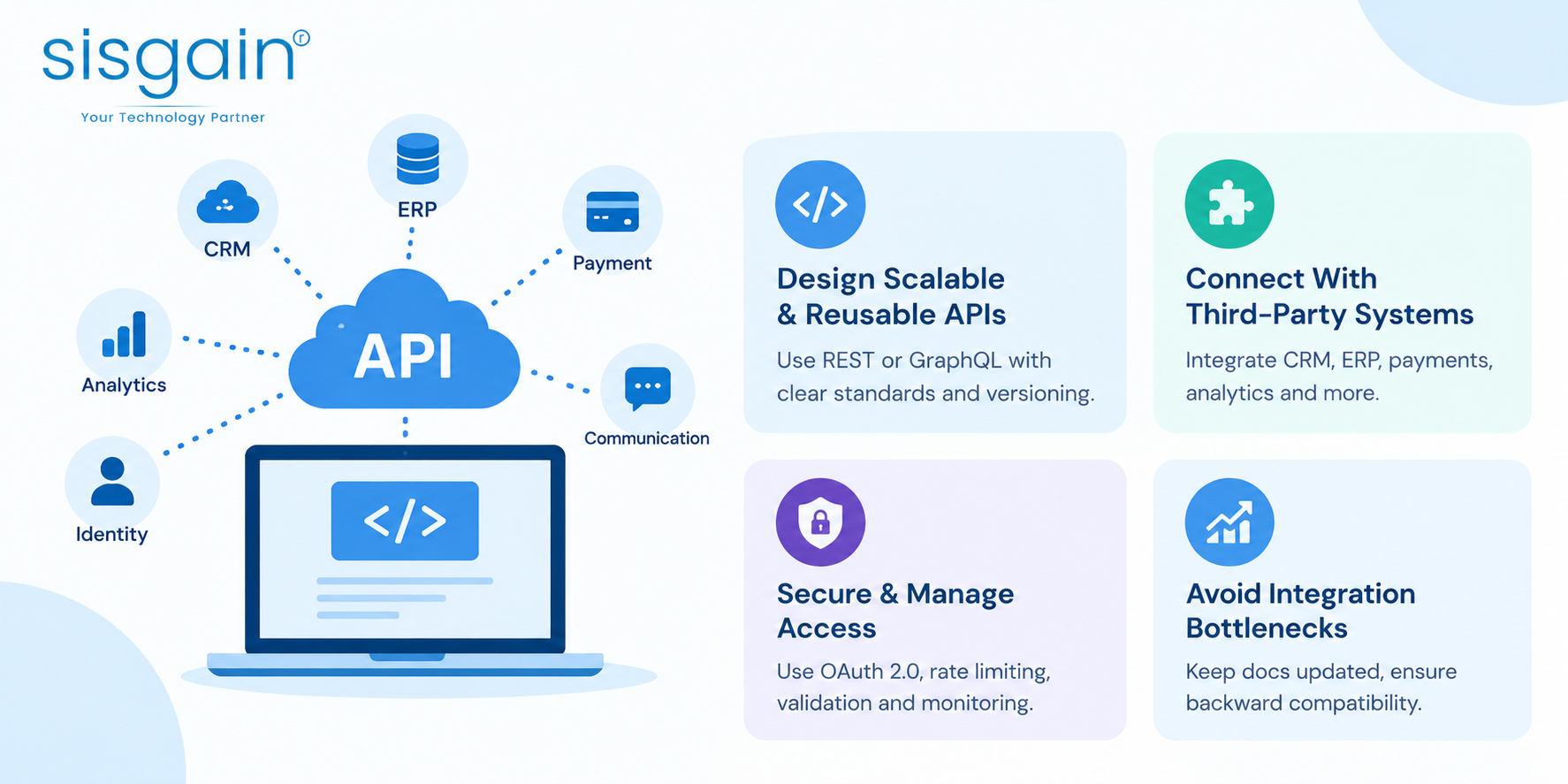
An API-first approach means designing the interface before building the features that depend on it. Choose the style that fits your use case: REST is widely supported and simple, while GraphQL offers flexible data queries for complex front ends. Use consistent naming, predictable error responses, and clear versioning so that other developers can build on your platform with confidence.
Connect SaaS Platforms With Third-Party Systems
Integrations increase the value of your product. Typical examples include CRM and ERP systems, payment gateways, analytics platforms, identity providers, and communication tools. Each integration should have a defined purpose, error handling, and monitoring, because a failing third-party connection can quickly become a customer-facing problem.
Secure APIs and Manage Access
Protect every endpoint with strong authentication and authorization, such as OAuth 2.0 and scoped access tokens. Apply rate limiting to prevent abuse, validate all input, and monitor API traffic for unusual patterns. Security reviews should be part of every API release.
Avoid Integration Bottlenecks as Products Grow
As your customer base expands, poorly managed APIs become a source of friction. Maintain up-to-date documentation, preserve backward compatibility wherever possible, and announce deprecations well in advance. When integration needs become complex, it helps to evaluate api development companies on their experience with versioning, security, and large-scale system connectivity, not only on price.
Choose the Right SaaS Product Development and Scaling Strategy
Building the product is only part of the journey. Scaling it profitably requires discipline in infrastructure, pricing, and measurement.
Build an MVP and Validate Product-Market Fit
An MVP contains only the features needed to solve the core problem for early users. Launch it to a focused audience, track whether they return and recommend it, and use their behavior to decide what to build next. Product-market fit is visible when users keep coming back and acquisition becomes easier over time.
Scale Infrastructure Based on Actual Usage
Avoid over-engineering before demand exists. Monitor workloads, then scale where real bottlenecks appear. Horizontal scaling, caching, content delivery networks, and database optimization such as indexing and read replicas are common tools. Auto-scaling helps match cost to traffic, which protects margins during growth.
Optimize SaaS Pricing and Subscription Models
Pricing is a product decision. Tiered plans suit products with clear feature segments, while usage-based billing works well when value scales with consumption. Compare your customer acquisition cost with customer lifetime value to make sure growth is profitable, and review retention data before changing prices.
Measure Product Performance With Meaningful KPIs
For effective SaaS product development, track a focused set of indicators: monthly recurring revenue (MRR), churn rate, customer lifetime value (CLV), activation rate, and feature adoption. Avoid vanity metrics such as total sign-ups that do not reflect real engagement.
As the product matures, many companies compare in-house teams with outsourcing SaaS development. The decision usually depends on four factors: budget, available technical expertise, time-to-market, and long-term maintenance. Outsourcing can speed up delivery and fill skill gaps, while an in-house team offers deeper domain knowledge and tighter control. A hybrid model, where a partner supports specific phases, is also common.
Build a Long-Term Product Engineering and Modernization Roadmap
Every successful product eventually faces aging code, outdated dependencies, and rising maintenance effort. A long-term plan keeps these issues from slowing innovation.
Identify Legacy Systems and Technical Debt
Technical debt is the cost of earlier shortcuts. Warning signs include slow releases, frequent regressions, tightly coupled components, unsupported libraries, and engineers who avoid touching certain parts of the codebase. Catalog these problems, estimate their business impact, and rank them so that the most harmful issues are addressed first.
Modernize Software Without Disrupting Operations
A full rewrite is risky and often takes longer than expected. Incremental refactoring is usually safer. Approaches such as the strangler pattern replace old components step by step while the system stays live. Always plan migrations carefully, run compatibility tests, and keep a rollback option.
Align Engineering Investments With Business Outcomes
Teams must balance new features, reliability, scalability, and technical improvements. A simple practice is to reserve a fixed share of each sprint for platform health. This makes maintenance a planned activity instead of an emergency.
Collaborate Across Product, Engineering, and Integration Teams
Large platforms involve many stakeholders. Shared technical standards, clear governance, and defined accountability keep work consistent across teams. For complex programs involving several vendors and legacy platforms, product engineering strategy partners for system integrators can help coordinate engineering roadmaps, manage intricate integrations, and guide modernization initiatives from planning to delivery.
Common Software and SaaS Development Mistakes to Avoid
Most failures follow familiar patterns. Recognizing them early saves time and money.
Building Too Many Features Before Validating Demand
Impact: Budget is spent on features nobody uses, and launch is delayed. Corrective action: Release a focused MVP, measure real usage, and let evidence guide the next investment.
Ignoring Security, Scalability, and Technical Debt
Impact: Breaches, outages, and slow development cost far more to fix later. Corrective action: Include security reviews, load testing, and debt reduction in your regular delivery process.
Choosing Technology Based on Hype Instead of Business Needs
Impact: Teams adopt tools they cannot maintain, which increases cost and risk. Corrective action: Evaluate technology against requirements, team skills, ecosystem maturity, and long-term support.
Neglecting Customer Feedback and Product Analytics
Impact: The roadmap drifts away from customer needs, and churn rises. Corrective action: Set up analytics from the first release and schedule regular feedback reviews.
Underestimating Cloud, AI, and Maintenance Costs
Impact: Margins shrink as usage grows, especially with AI inference and data storage. Corrective action: Model costs at different usage levels, set budget alerts, and review cloud spending monthly.
Read More :- How Cloud Managed Services and FinOps Cut Costs While Scaling Business Growth
How to Measure the Success of Your Software and SaaS Development Strategy
A strategy is only useful if you can tell whether it is working. Track metrics across product, engineering, and business dimensions.
Product and Customer Metrics
Measure adoption rate, activation rate, retention, churn, and customer satisfaction. These show whether users find lasting value in your product.
Engineering Performance Metrics
Track release frequency, deployment lead time, defect rates, and recovery time. They reveal how reliably your team turns ideas into working software.
Business and Financial Metrics
Monitor development cost, time-to-market, recurring revenue, and return on investment to confirm that engineering work supports business goals.
| KPI | What It Measures | Why It Matters | Review Frequency |
|---|---|---|---|
| Activation rate | Share of new users who reach a key first action | Shows whether onboarding delivers early value | Weekly |
| Churn rate | Customers or revenue lost in a period | Indicates retention and product satisfaction | Monthly |
| Monthly recurring revenue (MRR) | Predictable subscription income | Tracks business growth | Monthly |
| Customer lifetime value (CLV) | Expected revenue per customer over time | Guides acquisition spending and pricing | Quarterly |
| Deployment frequency | How often code reaches production | Reflects delivery speed | Weekly |
| Change failure rate | Share of releases causing incidents | Measures release quality | Monthly |
| Time to restore service | Time needed to recover from failure | Reflects resilience | Monthly |
| Time-to-market | Duration from idea to release | Shows ability to respond to demand | Quarterly |
Establish a Continuous Improvement Framework
Review your KPIs on a fixed schedule, compare them with targets, and decide what to change. Run retrospectives after releases and incidents, document lessons learned, and adjust priorities based on evidence rather than assumptions.
Final Thoughts
Staying competitive in software and SaaS is not about adopting every new trend. It is about making sound decisions in the right order: validate demand, choose the right development model, build a scalable and secure architecture, add AI where it creates real value, deliver through agile and DevOps practices, connect your product through reliable APIs, and keep improving based on measurable results.
The best strategy always reflects your customers’ needs, your technical constraints, and your business outcomes. Start with the area that currently limits your growth the most, measure the impact, and build from there.
If you are planning a new product or want to strengthen an existing platform, speak with an experienced development team about your software or SaaS requirements. A focused discussion can help you identify priorities, reduce risk, and move forward with a clear roadmap.
Frequently Asked Questions About Software and SaaS Development Strategies
What are the most effective software development strategies for 2026?
The most effective strategies include validating market demand early, using cloud-native architecture, adopting agile delivery, automating CI/CD pipelines, integrating AI where it adds clear value, designing API-first products, and tracking measurable KPIs. Together, these practices help teams release faster while keeping quality, security, and costs under control.
How do SaaS development services help businesses scale?
SaaS development services provide architecture design, multi-tenant engineering, security, cloud infrastructure, and ongoing optimization. By building on scalable foundations and automating operations, businesses can add customers, handle higher traffic, and release improvements continuously without rebuilding the product as demand grows.
What is the difference between custom software development and SaaS development?
Custom software is built for a specific organization and its unique workflows, usually with full ownership. SaaS is a hosted product sold to many customers through subscriptions, with the provider managing updates and infrastructure. The right choice depends on customization needs, budget, and growth plans.
How can businesses reduce SaaS development costs without compromising quality?
Start with a focused MVP, prioritize features using customer data, and automate testing and deployment. Use managed cloud services where appropriate, monitor infrastructure spending, and avoid unnecessary complexity. Regular code reviews and technical debt management also prevent expensive rework later.
How does AI improve software and SaaS product development?
AI can improve products through intelligent search, personalization, predictive insights, and support automation. It can also assist development with code suggestions and test generation. Results depend on data quality, careful evaluation, and human oversight, so start with measured pilots before wider rollout.
When should a business outsource SaaS development?
Outsourcing is worth considering when you lack specific technical skills, need to reach the market quickly, or want to control fixed hiring costs. Evaluate the partner’s experience, communication, security practices, and maintenance support. Many businesses choose a hybrid model that keeps product strategy in-house.
How can DevOps improve software delivery and reliability?
DevOps improves delivery by automating builds, testing, and deployments, which reduces manual errors and shortens release cycles. Monitoring and incident response practices help teams detect and fix problems faster. The result is more frequent releases with fewer failures and quicker recovery.