Glass is often chosen for offices and commercial interiors because it keeps spaces bright and visually connected. But when too much activity is visible through a partition, door, or window, the same openness can become inconvenient.
Frosted glass graphics offer a practical way to change that balance. They can reduce direct visibility, add visual detail, and give a commercial space a more finished appearance without replacing the existing glass.
Before choosing a design, however, businesses should think about how the glass is being used and what they actually want the treatment to achieve.
Why do businesses add frosted graphics to glass?
The answer depends on the space.
A meeting room may need more privacy during discussions. A reception entrance may need a visible brand element. A clinic may require stronger screening around consultation areas, while a showroom may want decorative graphics without hiding products completely.
In other words, the purpose can be practical, visual, or a combination of both.
A simple way to define the requirement is to ask whether the glass needs to provide:
- better visual privacy
- clearer room separation
- business branding
- decorative detail
- improved visibility of a transparent door
- a more organised interior appearance
Once the main purpose is clear, the design becomes easier to plan.
Does the whole panel need to be covered?
Not necessarily.
Many commercial spaces benefit from treating only selected sections of the glass. A horizontal privacy area, for example, can interrupt direct sightlines while leaving other parts transparent.
This can be useful where businesses still want natural light and a sense of openness.
For areas requiring greater discretion, wider coverage may be more appropriate. The important point is that the amount of treatment should follow the room’s purpose rather than applying the same coverage to every panel.
Can branding be added without making the glass look like an advertisement?
Yes.
Branding can be incorporated into the glass in a relatively restrained way. A company name, logo, or simple visual element can become part of the design instead of appearing as a separate sign.
For example, frosted logo graphics with a clear surrounding area can keep the central brand element noticeable while preserving transparency across much of the panel. This can work well on reception doors, office entrances, meeting rooms, and customer-facing glass.
The size of the branding should match the viewing distance. A large reception area may allow a larger mark, while an internal office door often suits a smaller treatment.
What if a business wants privacy and branding together?
That is possible, but the two elements need to be planned together.
A busy design can make both the logo and the privacy pattern harder to read. A cleaner arrangement usually works better, especially in professional environments.
One option is to use a frosted area as the visual background and keep a selected logo or lettering element clear. Another is to make the branding itself part of the frosted pattern.
The best arrangement depends on the glass dimensions, the surrounding interior, and how close visitors will be to the panel.
Are subtle designs better for offices?
Often, they are easier to integrate.
Corporate offices frequently use simple lines, balanced spacing, soft patterns, or controlled areas of frosting because these choices fit naturally with desks, lighting, signage, and modern furniture.
That does not mean every office needs a plain design. The important factor is visual balance.
A business with a creative interior may prefer stronger shapes or decorative artwork, while a formal workplace may benefit from a quieter treatment.
What if complete frosting feels too heavy?
A fading effect can provide another option.
Instead of moving directly from clear glass to a solid frosted area, fade-effect privacy graphics create a gradual transition. This can help concentrate screening where it is needed while preserving clearer sections elsewhere.
This approach can be useful for executive rooms, meeting spaces, reception glazing, and other areas where businesses want privacy without making the glass appear completely covered.
It can also create a softer visual result than a hard boundary between clear and frosted sections.
Can frosted graphics carry detailed artwork?
Yes, provided the design suits the glass and the intended viewing distance.
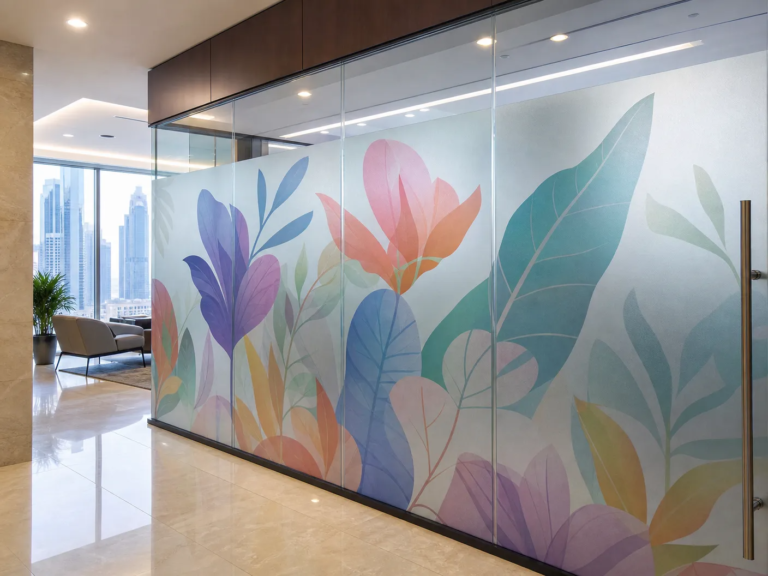
Printed translucent glass graphics can combine a frosted appearance with colours, logos, text, patterns, or custom artwork. This can be useful in showrooms, retail spaces, reception areas, restaurants, and other customer-facing environments.
The design should still be judged by its surroundings. Too many colours or competing elements may make a small glass panel feel crowded.
A strong design is usually one that remains easy to understand from the distance at which visitors will see it.
How should businesses choose between decoration and privacy?
Start by identifying the main problem.
If people can see directly into a room and that is causing discomfort, privacy should lead the decision. If the glass is mainly blank and needs visual improvement, decorative treatment may be more important.
Sometimes the two needs overlap.
For example, a meeting-room partition can use a decorative centre section that also blocks direct views. A reception door can combine branding with a small privacy area. A showroom window can include graphics while keeping its most important display areas visible.
Does the type of glass surface change the design?
Yes.
A fixed partition gives designers more freedom because it does not move or include hardware. A glass door has handles, hinges, opening paths, and safety considerations that should influence placement.
A shop window may need to remain highly visible from outside, while an internal consultation-room partition may prioritise privacy.
For this reason, designs should be prepared around the actual glass dimensions rather than simply choosing a standard pattern and applying it everywhere.
What should be checked before production?
Several practical details are worth reviewing first.
Where are the main sightlines?
This identifies the sections where privacy treatment will have the greatest effect.
How much of the glass should remain transparent?
This affects natural light and the visual openness of the room.
Will the design include branding?
Logo placement should be planned before the final artwork is prepared.
Are there several adjoining panels?
Repeated elements should line up so the finished installation looks consistent.
Are handles, signs, switches, or furniture close to the glass?
These can affect where patterns and graphics should be positioned.
A little planning at this stage can prevent awkward placement later.
Is this suitable for Dubai businesses?
Yes, particularly for commercial interiors where glass is used extensively.
Offices, clinics, hotels, showrooms, salons, restaurants, retail spaces, and coworking environments can all have different reasons for changing the appearance or visibility of their glass.
In Dubai, the same design should not automatically be used across every type of property. A corporate meeting room may need a more restrained look, while a retail or hospitality space may have more freedom for decorative graphics.
Local conditions are also worth considering when multiple panels are involved. Consistent measurements, placement, and finishing can make a significant difference to the final appearance.
What is the simplest way to choose a design?
Think about the result before thinking about the pattern.
Do you want people outside the room to see less? Do you want visitors to recognise a branded entrance? Do you want to make a plain partition more interesting? Or do you need a combination of all three?
Once the desired outcome is clear, compare design choices according to their function.
A privacy band may suit a straightforward office. A fade effect may be useful where a softer transition is preferred. A custom graphic can work when branding or decoration plays a larger role.
Final thought
Adding a frosted treatment to glass is not simply a matter of choosing an attractive pattern. The most useful result comes from matching the design to the way the space is actually used.
Privacy requirements, natural light, branding, room layout, viewing angles, and the surrounding interior should all influence the final decision. When those factors are considered together, existing glass can remain open and useful while offering a more controlled and purposeful appearance.