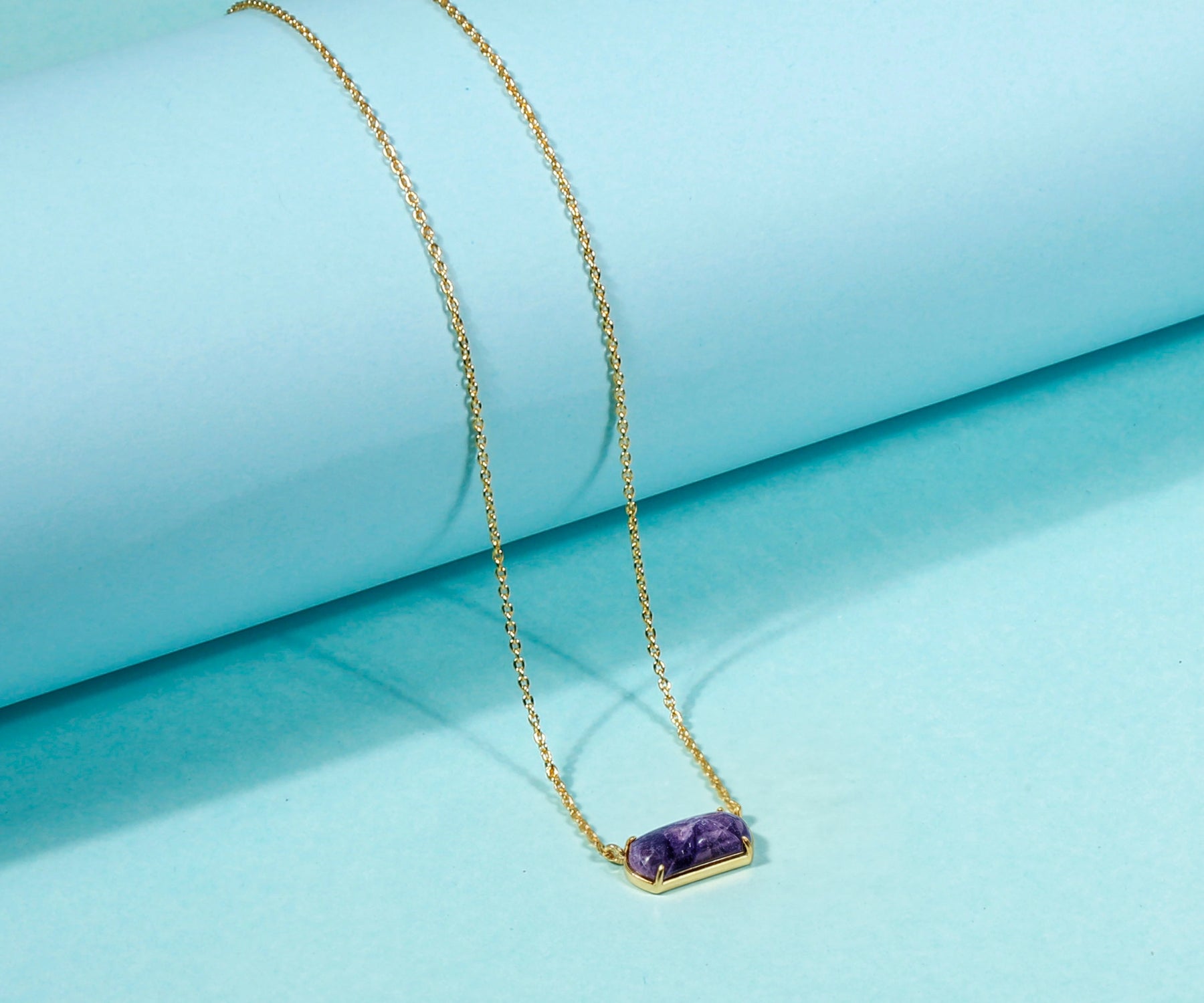
A necklace that sits too high feels tight, and one that hangs too low can disappear under your neckline. Getting the length right starts with a few simple measurements. That matters even more with a stone piece like a charoite necklace, where the purple swirls deserve to land exactly where people will notice them. This guide shows how to measure your neck, read standard lengths, and choose a fit that suits your outfit.
What You Need Before You Start
Measuring for a necklace takes about five minutes and needs very little equipment. A soft sewing tape is the easiest tool. If you only have a rigid ruler, use a piece of string, ribbon, or unwaxed dental floss, then lay it against the ruler afterward.
Set yourself up properly before you begin. Stand in front of a mirror with relaxed shoulders and your chin level, since tilting your head up or down changes the measurement slightly. Wear the top you plan to pair with the necklace, or at least one with a similar neckline. Move your hair out of the way so the tape sits directly against your skin.
A pen or a small piece of tape for marking the string will also help. Most U.S. jewelry listings use inches, so measure in inches from the start and avoid converting later.
How to Measure Your Neck Step by Step
Two separate measurements answer two different questions. Your neck circumference tells you the shortest necklace that will fit without pinching. Your preferred drop point tells you where the piece should land on your chest.
Finding Your Neck Circumference
Wrap the tape or string around the base of your neck, just above the collarbones, where a snug choker would rest. Keep it level all the way around. A tape that tilts at the back adds length that is not really there.
Slide one finger between the tape and your skin. That small gap approximates how a necklace feels when it is comfortable rather than tight. Read the number where the tape overlaps and write it down. Many adults measure somewhere between 12 and 17 inches, although body build varies widely.
Finding Where the Pendant Should Land
Drape a length of string around your neck and let both ends hang in front. Slide your fingers down until the string reaches the spot where you want the center of the necklace to sit, such as the hollow of the throat, the collarbone, the breastbone, or lower. Pinch both ends together at that point, remove the string without letting go, and lay it flat against a ruler.
The measurement from one end to the other is your target necklace length. Keep in mind that chain length in most listings does not include the pendant. A pendant hangs from a small loop called a bail, so the stone itself will sit a little lower than the chain’s lowest point.
Measuring a Necklace You Already Own
If you already have a necklace that sits the way you like, measure it instead. Unclasp it, lay it straight on a flat surface, and measure from one end of the chain to the other, including the clasp. This is often the most reliable method, because it reflects how a piece actually behaves on your body. It also works well when you are buying a gift and can borrow something from the recipient’s jewelry box.
Standard Necklace Lengths and Where They Fall
Jewelers use a set of named lengths, and learning them makes shopping much easier. The table below shows the common categories, their sizes in inches and centimeters, and where each typically rests on an average adult. Treat the placements as starting points, because torso length and neck size shift them by an inch or more.
Table: Standard Necklace Lengths and Typical Placement
| Style Name | Length (Inches) | Length (cm) | Where It Typically Rests | Works Well For |
|---|---|---|---|---|
| Choker | 14–16 | 35–41 | Snug at the base of the neck | Open necklines, strapless tops |
| Princess | 17–19 | 43–48 | At or just below the collarbone | Everyday wear, most pendants |
| Matinee | 20–24 | 51–61 | Between collarbone and bust | Crew necks, business attire |
| Opera | 28–36 | 71–91 | At or below the bust line | Layering, long single strands |
| Rope | Over 36 | Over 91 | At the waist or longer | Wrapping or knotting |
Because the lengths overlap slightly, a 16-inch strand might feel like a choker on one person and a collar-length piece on another. The 18-inch princess length is often treated as the most versatile starting point. It flatters many necklines and suits both small and mid-sized pendants.
Matching Necklace Length to Your Neck Size and Build
Your neck circumference sets the lower limit. A necklace shorter than your neck measurement will not close, and one equal to it will feel like a collar. For a comfortable choker, most people add roughly one to two inches to their measurement. If your neck measures 13 inches, a 15-inch strand usually sits close without squeezing.
Slimmer or Shorter Necks
On a slim or shorter neck, a long necklace can look as though it is dragging the eye downward. Princess length often feels balanced, and a short choker can look crowded if it covers much of the visible neck. Small, delicate pendants tend to look proportionate here. Larger focal pieces usually work best on a longer chain, where they have room to rest on the chest.
Fuller Necks
A fuller neck may find a 14-inch choker uncomfortable even when the measurement technically fits. Moving up to 17 or 18 inches gives the piece room to lie naturally and avoids the pressure that makes people take a necklace off after an hour. Longer lengths also create a vertical line that many wearers like. Comfort should still lead, since fashion rules are guidelines rather than requirements.
Torso Length and Height
Height and torso length change where a given necklace lands, so a standard chart cannot predict everything. A 20-inch necklace may reach the bust on a petite wearer and the upper chest on someone taller. If you are shorter, check where the pendant would fall before buying. If you are tall, you may prefer to go an inch or two longer than the general chart suggests.
Choosing a Length for Your Neckline
The neckline of what you wear is just as important as your neck. The goal is to avoid collisions between the necklace and the collar, and to let the piece frame the open space instead.
A V-neck leaves a triangle of skin, and a pendant that follows the point of the V looks intentional. Choose a length that places the pendant inside the opening without hiding beneath the fabric. A crew neck usually works best with either a short choker above the collar or a longer matinee strand that hangs fully below it. A necklace that ends just at the edge of a crew neck can look cluttered.
Scoop and sweetheart necklines pair well with princess lengths, since the necklace follows the curve of the fabric. High necks and turtlenecks call for a longer chain worn over the top, typically opera length or beyond. Strapless and off-shoulder tops show the collarbone and neck, which makes this the natural place for a choker or a collarbone-length piece.
If you are unsure, hold the necklace up against the garment in a mirror. Thirty seconds of testing prevents most length regrets.
Fit Notes for Gemstone and Beaded Necklaces
Gemstone jewelry behaves differently from a plain metal chain. Beaded strands do not flex the way fine chains do. Rigid round beads form a stiffer ring around the neck, so a beaded strand often feels a little tighter than a chain of the same listed length. If you are between sizes, adding an inch to a beaded strand is a sensible choice.
Charoite is a good example of why placement matters. The stone is known for lilac to deep violet colors with swirling patterns, and it sometimes carries black or pale flecks. Commercial supply is generally traced to one region in Yakutia, Russia. Because the pattern is the main attraction, you want the pendant or beads to sit where light and conversation naturally reach them, often at collarbone or just below.
Charoite is also moderately soft. It is generally rated around 5 to 6 on the Mohs hardness scale, so it can pick up scratches from harder materials. A longer necklace that swings freely may knock against belt buckles, zippers, or desk edges. A princess length or a shorter strand tends to stay out of harm’s way, which can help the stone’s polish last.
Weight matters too. A large stone pendant pulls a thin chain forward and can make the necklace sit lower than expected. If the pendant is heavy, choose a sturdier chain and test the length with the weight attached rather than measuring the chain alone.
Adjustable Chains, Extenders, and Clasps
If you cannot decide between two lengths, an adjustable design removes much of the risk. Many necklaces come with a small extender chain of about two inches, which lets you shift the length in steps. This is useful if you wear the same piece with different necklines or if your measurement falls between two standard sizes.
Sliding knots on cord necklaces offer an even wider range, and they suit lightweight pendants well. Check the clasp as well. A lobster clasp is easier to handle than a tiny spring ring, especially if you struggle with small fasteners. If you often put on a necklace without help, choose a clasp you can fasten at the back of your neck without a mirror.
Common Measuring Mistakes to Avoid
A few errors cause most sizing problems. Watch for these:
- Pulling the tape too tight. Measuring snugly gives a number that will feel uncomfortable in practice. Leave a finger’s width of room.
- Forgetting the pendant drop. Chain length and pendant length are separate, so the stone will hang lower than the chain alone.
- Mixing units. Switching between centimeters and inches mid-measurement leads to ordering the wrong size.
- Measuring over thick clothing. A collar or scarf adds length that disappears when you remove it.
- Assuming all 18-inch necklaces fall in the same place. Neck size, torso length, and chain stiffness all change the result.
Another common problem is measuring only once. Take the measurement twice and compare. If the numbers differ by more than half an inch, repeat it with a relaxed posture.
Buying Online Without Trying It On
Shopping online adds a layer of uncertainty because you cannot hold the necklace against yourself. A few habits reduce the risk. First, read the listing carefully to see whether the stated length is end to end, and whether it includes an extender. Look at the bead size or pendant dimensions as well, since a large stone changes how the whole piece sits.
Before ordering, cut a string to the listed length and drape it around your neck. This costs nothing and shows exactly where the necklace will land. Compare that spot with your outfit rather than relying on a chart alone.
Finally, check the seller’s return policy. Many U.S. retailers accept returns on jewelry within a set window, but terms differ, and some exclude custom or sale items. Knowing the policy before you buy gives you room to exchange a length that turns out slightly off.
Conclusion
The right necklace length comes from two simple measurements: your neck circumference and the spot where you want the piece to land. Use a soft tape or string, leave a finger’s width of comfort, and compare your numbers with standard lengths such as choker, princess, and matinee. Consider your neckline, torso length, and the rigidity or weight of the piece before you decide. When you are between sizes, an adjustable chain or a quick string test can settle the question. Measure carefully once, and you will choose with far more confidence.
FAQs
1. How much should I add to my neck measurement for a comfortable necklace?
Most people add about one to two inches. A snug choker usually needs closer to one inch, while a relaxed fit needs closer to two. Always keep a finger’s width of space when measuring.
2. What is the most common necklace length?
The 18-inch princess length is widely considered the most versatile. It sits near the collarbone on many people and suits both small pendants and simple chains.
3. Is necklace length different for men?
The measuring method is identical, but men’s necklaces are often longer and thicker because of larger neck sizes. Many fall between 18 and 24 inches, depending on the chain width and personal preference.
4. Can I measure my neck without a tape measure?
Yes. Use string, ribbon, or dental floss, wrap it around your neck, mark where it meets, and measure it against a ruler. This works just as accurately as a sewing tape.
5. Which length works best for a stone pendant?
Princess length suits small or medium stones, because they sit near the collarbone where they are easily seen. Larger or heavier pendants often look better at matinee length, where they have space to rest on the chest.